

Giant Brains, or Machines That Think#
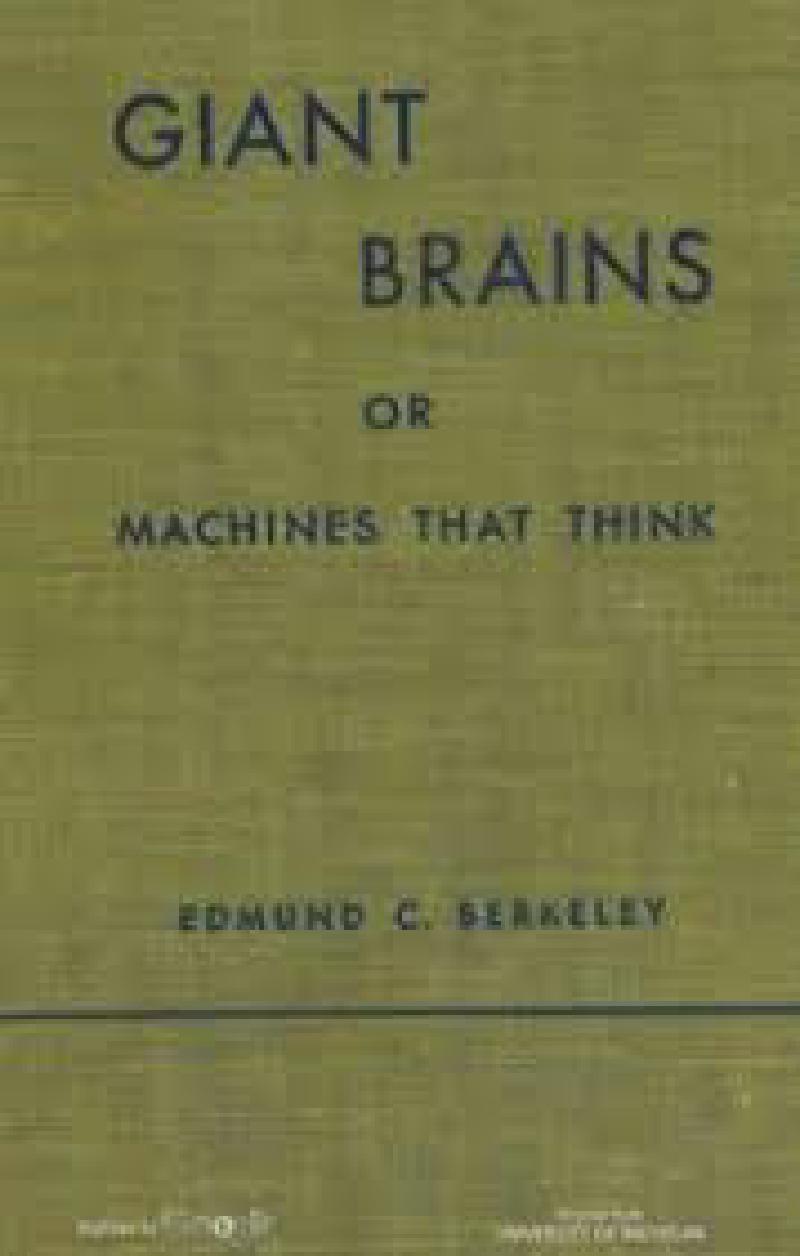
As technological advances surged in the late 1940s, so did curiosity about what these machines truly were. In 1949, professor Edmund Callis Berkeley published Giant Brains, or Machines That Think — a book that introduced the general public to the potential of mechanical brains. For Berkeley, the computers of that era were already remarkable: performing the work of hundreds of people, solving complex problems in science, business, and government.
The question was no longer if machines could be useful. It was whether they could think.
Alan Turing and The Imitation Game (1950)#
In 1950, Alan Turing published his landmark paper “Computing Machinery and Intelligence”, where he proposed a practical way to test whether a machine could exhibit intelligent behavior — The Imitation Game.
Before introducing the machine into the equation, Turing described a social game common at the time. Three participants are involved: a man (A), a woman (B), and an interrogator (C) of any gender.
Setup: The interrogator sits in a separate room and communicates with A and B only through text — so they can’t recognize voices.
The Goal: The interrogator must figure out who is the man and who is the woman by asking questions.
The Roles:
- The man (A) tries to deceive the interrogator, pretending to be the woman.
- The woman (B) tries to help the interrogator, answering as honestly as possible.
Then Turing posed the real question:
What would happen if we replaced A or B with a machine? Would the interrogator be wrong just as often as when the game is played between a man and a woman?
This became known as the Turing Test — and it remains one of the most referenced benchmarks in AI to this day.
The Dartmouth Conference (1955)#
In 1955, John McCarthy organized a workshop at Dartmouth College, bringing together the leading minds working on machine intelligence. This was the moment the term “Artificial Intelligence” was used for the first time.
The Dartmouth Conference didn’t produce a breakthrough algorithm or a working AI system. What it did was far more important: it established AI as a formal academic discipline and gave the field a name, a community, and a direction.
LISP — The Language of AI Research (1958)#
McCarthy didn’t just name the field — he built tools for it. In 1958, he created LISP (List Processing), the first programming language designed specifically for AI research:
;; Define a function to find the nth Fibonacci number
(defun fibonacci (n)
  (if (< n 2)
      n
      (+ (fibonacci (- n 1))
         (fibonacci (- n 2)))))

;; Print the 10th Fibonacci number to the console
(format t "The 10th Fibonacci number is: ~A~%" (fibonacci 10))
LISP introduced concepts that are now standard in modern programming: recursion, dynamic typing, garbage collection, and tree data structures. It remained the dominant language in AI research for decades.
A fun fact: LISP was later adapted into Elisp, the language that powers the text editor Emacs — still used by programmers today.
The Early Pioneers#
The 1950s also saw the first practical demonstrations of machine learning:
- Arthur Samuel (1952) developed a checkers-playing program that could learn and improve on its own — the earliest example of self-teaching software.
- Samuel (1959) coined the term “machine learning”, describing methods for teaching computers to surpass their human programmers.
The Era of Optimism#
By the end of the 1950s, the mood was electric. Machines were playing games, solving mathematical proofs, and processing language. Researchers genuinely believed that human-level AI was just around the corner.
That optimism would eventually meet reality — but that’s a story for the next post.
References#
- The History of Artificial Intelligence — Tableau
- John McCarthy — Computer History Museum
- Artificial Intelligence (AI) Coined at Dartmouth — Dartmouth College
This is post 1 of the Origins of AI series — tracing the history of artificial intelligence from the 1950s to the agentic systems of today.